This article has been authored by Mabel Nash Greenberg, AVP – InnerTalent at InnerGroup
Unpopular opinion: it’s still important to have people in the conversation.
Everyone is talking about AI like it’s the one thing that will define the future of work — and they’re not wrong. It already has been transformative, and the pace is only accelerating.
What’s becoming clear is that the real differentiator won’t be the technology itself, but how people use it.
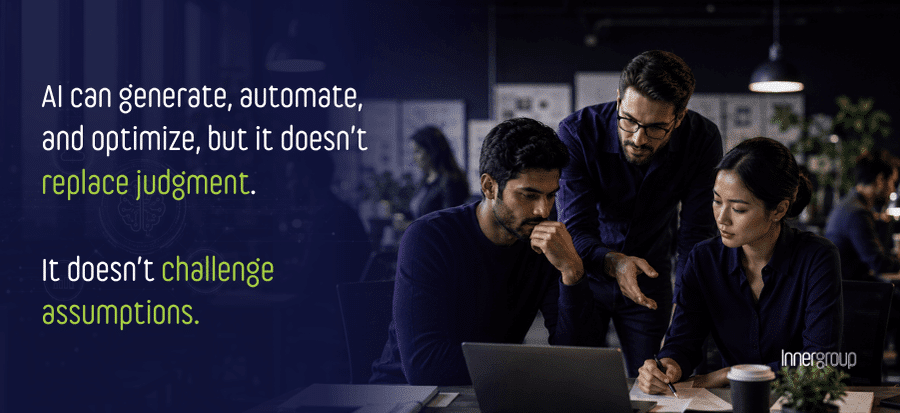
AI can generate, automate, and optimize, but currently, it doesn’t replace judgment. It doesn’t challenge assumptions. It doesn’t bring diverse, lived experiences into the room or ask the one question that reframes the entire problem. And we’ve seen the downside of that, with AI’s tendency toward agreement, sycophancy, and reinforcing what’s already there.
But the narrative is shifting.
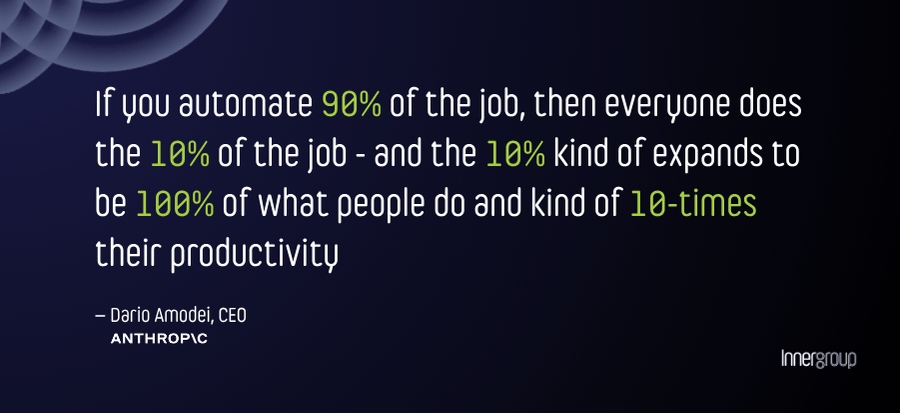
In fact, even the leaders who once predicted AI would wipe out white-collar work are walking it back. Anthropic CEO Dario Amodei, who once claimed AI could eliminate 50% of white-collar jobs, now describes it as a multiplier of output: “If you automate 90% of the job, then everyone does the 10% of the job and the 10% kind of expands to be 100% of what people do and kind of 10-times their productivity.”
OpenAI’s Sam Altman has similarly reversed course, saying he was “pretty wrong” about AI’s impact on jobs. (Source: Sam Altman and Dario Amodei are both walking back their AI jobs apocalypse prophecies as they eye blockbuster IPOs | Fortune)
The apocalypse, it turns out, has been postponed.
The Starbucks story is instructive here: as an early adopter of AI, the company invested in an AI-powered inventory tool and gained valuable insights into where automation creates value and where human judgment remains essential. The experience reinforced that while AI can accelerate certain operational tasks, frontline employees continue to play a critical role in managing complexity, context, and exceptions that technology alone cannot always handle. (Source: Exclusive: Starbucks scraps AI inventory tool across North America | Reuters)
The Problem: Optimizing for Efficiency at the Expense of People
The best decisions, the ones that actually move businesses forward, are not made in a vacuum. They come from tension, from diverse perspectives, from people who know how to think critically and design solutions for other people. And that is not going to change anytime soon.
Yes, technology is incredibly important. It helps us work more efficiently, and ultimately spend more time in our ‘zone of genius.’ The people who learn to leverage these tools to strengthen their own talents, will guide us into the future, without a doubt.
Research from Stanford’s Digital Economy Lab bears this out: in roles where AI was used to augment human work, headcounts actually grew faster than average. It was only in roles where tasks were fully automated — with minimal human involvement, that employment declined.
The data supports what good operators already know intuitively: augmentation outperforms replacement. (Source: A reality check on the AI jobs hysteria | MIT Technology Review)
But, there’s a risk in how this conversation is evolving—that we start designing systems and workflows that optimize for efficiency at the expense of meaning. After all, we don’t want to design a solution that will lead to humanity’s obsolescence.
What This Means for In-House Marketing Teams
Work isn’t just output. It’s the relationships we build, the ideas we elevate, and the culture we create together. That’s what makes people want to show up, contribute, and stay.
For in-house agencies specifically, this tension is acute. These teams are already under pressure to do more with less and AI tools promise relief. But the in-house marketing talent that makes these teams genuinely effective isn’t just executing tasks. They’re embedded in the brand, fluent in its voice, and trusted to make judgment calls that no algorithm can replicate.
Replacing human expertise with automation may improve efficiency in the short term, but it introduces different risks—such as loss of context, brand judgment, institutional memory, creativity, and even resilience.
The companies that get this right won’t treat AI as a replacement for people, but as a tool that frees great people to focus on what they do best—thinking, creating, connecting, and leading.
The Solution: Marketing Staff Augmentation That Puts People First
So, this shouldn’t be an either/or conversation. The future belongs to the people who can leverage emerging technology and AI to clear the noise, while doubling down on their own perspective, creativity, and ability to collaborate.
At InnerTalent, that’s exactly the philosophy behind how we work. We place specialized marketing and creative talent directly within in-house agency teams — not to replace what’s there, but to strengthen it. Flexible, embedded, and ready to contribute from day one, our talent brings the human skills in the age of AI that matter most: critical thinking, creative judgment, and the ability to collaborate across complex organizations.
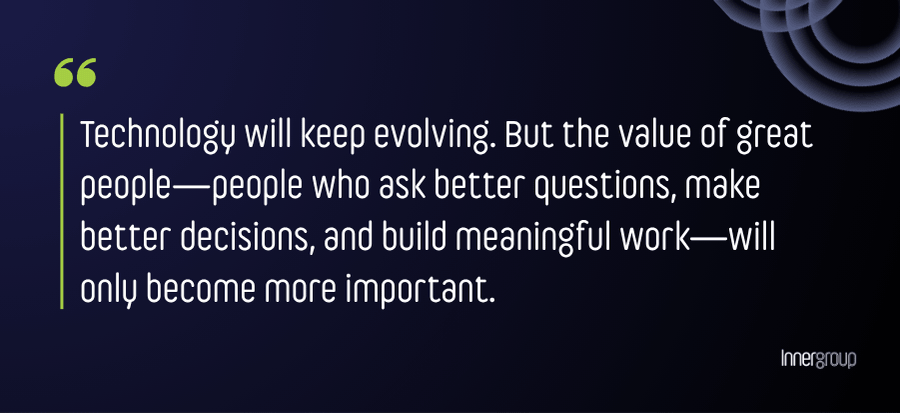
Technology will keep evolving. But the value of great people—people who ask better questions, make better decisions, and build meaningful work—will only become more important. And for in-house marketing operations leaders looking to build teams that can thrive in both worlds — the AI-powered and the deeply human, the answer isn’t less talent. It’s the right talent, in the right roles, empowered by the right tools.