

Brands want their marketing to move fast, without losing control and compromising results. This is the obvious question you’re asking as a brand – What’s better – in house marketing vs. agency? Should we set up an in-house team or hire an agency? Here’s what most brands get wrong about this question – it’s a false choice.
The real decision isn’t in-house vs. agency. It’s understanding what you actually need for building scalable, future-proof and resilient marketing operations. In 2026, this cannot be an either/or answer. It’s both.

46% of brands now use a hybrid model for their marketing operations that combines the strengths of in-house marketing teams with the flexibility of external support. And the gap between this group and teams stuck in pure in-house or pure agency models is massive.
If you’re mulling over whether to hire a marketing agency or keep things in-house, this guide will walk you through that decision. By the end, you’ll know exactly what to do next. You’ll also see why the best choice is not what you first thought.
What Is an In-House Agency – Understanding the Model
Definition: In-House Agency
An in-house agency is a dedicated internal marketing team owned and operated by your brand. It’s your people, your processes, your direction. No external dependencies. Complete control over your marketing operations.
In theory, this sounds ideal. In practice, it’s more complicated.
How in-house agency is different from traditional agencies – agency vs in house
In-house agencies own the work. They’re not juggling five clients. They focus entirely on your business, your brand, and your goals.
Traditional agencies juggle. They bring expertise across industries and clients. But they’re split between multiple organizations. Your project is one of many.
That’s the fundamental difference. In house agency is singular focus. External agency is distributed expertise.
The Structure of an In-House Agency
In-house teams vary wildly by size. But they typically include:
Small in-house (2-4 people):
- Marketing manager (strategy + execution)
- Content creator
- Maybe a designer or analyst
In this setup, everyone does everything. Strategy, execution, optimization, firefighting. The work is consistent. The overwork is predictable.
Mid-size in-house (5-10 people):
- Marketing director (strategy + leadership)
- Content team (2-3 people)
- Designer/video producer
- Analyst/operations person
Roles start to specialize. Work gets organized. But the team is still stretched—especially if content demand is high.
Larger in-house (10+ people):
- VP/Director level (strategy)
- Specialists (content, demand gen, brand, product marketing, analytics)
- Production team (design, video, copywriting)
This looks like a real agency, but it’s internal. It’s viewed as a cost center, but the control is complete.
How In-House Teams Actually Spend Their Time
When you build an in house marketing team, the goal is clear:
- 35-40% strategy: Planning campaigns, defining messaging, analyzing performance, setting direction for the business
- 40-45% execution: Creating content, running campaigns, managing tools and workflows
- 15-20% administration: Reporting, meetings, cross-functional planning
This balance works when the team has the right structure, clear prioritization, and capacity boundaries.
The Reality of Time Allocation
In practice, most in-house teams operate differently. Research shows in-house teams spend 65%+ of their time on execution, leaving only 35% for strategy.
This isn’t a sign of failure. It’s a structural reality of marketing operations. Here’s why it happens:
- Constant internal demand: Marketing requests flow in from sales, product, leadership, customer success. There’s always another project.
- No external buffer: Unlike agencies with clear project scopes, in-house teams handle open-ended requests. The line between “scope” and “scope creep” can blur.
- Internal relationships matter: Saying no to a VP or sales leader is harder than it sounds. The culture becomes “we can handle it” because relationships are at stake.
- Content production scales internally: You can always produce one more piece of content with your existing team. Outsourcing feels like an external expense when production is “free” (it’s just your people’s time).
- Unclear prioritization: Without a forcing function, teams work on what feels urgent rather than what’s strategic.
The outcome: Your strategic talent spends most of their time on execution. A CMO paid to set direction ends up managing content calendars. A strategist becomes a project manager.
What This Means for Your Team
This isn’t inevitable. Teams that maintain the 35-40% strategy allocation typically have:
- Clear, written prioritization frameworks
- Explicit capacity planning (saying “we can do X projects this quarter, not more”)
- Executive support for saying no
- Either outsourced production or automation for routine tasks
Understanding this dynamic helps you shape your team with intent. It also explains why a fully in-house model may not deliver the strategy you expect.
Benefits of an In-House Agency
Let’s be honest about the wins. In-house agencies do deliver real value.
Greater Control Over Branding and Messaging
This is the #1 advantage. Your brand voice, your values, your direction. It’s all in-house. No agency middleman translating your strategy. No external perspectives diluting your message.
For brands where differentiation is mission-critical (consumer brands, luxury, high-regulation industries), this control is valuable. You’re not competing for the agency’s attention. You’re not dealing with misaligned visions.
Enhanced Collaboration and Communication
Your team is in the same office (or Slack workspace). Decisions move fast. Questions get answered immediately. No email chains waiting for external account managers.
This speed matters, especially in marketing, where responsiveness to market changes is competitive advantage.
Tailored Marketing Strategies
Your team knows your business intimately. They understand your sales cycle, your customer, your competitive position. They’re not learning your industry, they live it.
That intimacy enables customized strategies that a generalist agency might miss. Your team can think strategically about your specific situation.
Strategic Design Integration
In-house designers understand your business strategy, your competitive position, and your customer. They’re not just executing briefs—they’re thinking strategically about design as a competitive advantage.
This leads to designs that work harder. Colors are chosen for brand differentiation, not convention. Typography supports your positioning. Layout decisions reflect user research your team has conducted. Design becomes strategic, not just decorative.
Trade-offs to Consider
In-house design does have drawbacks: higher fixed salary costs, potential gaps in specialized expertise (motion design, 3D, interactive design), and resource constraints when demand spikes. But for brands with consistent design needs and strong brand differentiation requirements, in-house typically wins.
Drawbacks of an In-House Agency
For every advantage, there’s a tradeoff. And these tradeoffs are serious.
Limited Access to External Expertise
Your in-house team is good at what they do. But there are gaps.
Do you need a demand generation expert? Video production? A PR specialist? AI strategy?
Your in-house team probably doesn’t have deep expertise in all of these. External agencies have breadth. In-house teams have depth, but only in the areas you’ve hired for.
Higher Fixed Costs
Salaries, benefits, office space, equipment, training—these are fixed costs. You pay them whether business is booming or quiet. When you need to scale back, you can’t just reduce your retainer. You have severance, knowledge loss, and rehiring costs.
This is why pure in-house doesn’t work well for cyclical businesses or brands in growth phase. The cost is fixed; the need is variable.
Potential for Resource Constraints
Your team has 40 hours a week. Not 50. Not 60 (if you want to avoid burnout).
That’s a hard ceiling. When marketing requests exceed capacity, something breaks:
- Quality drops
- Timeline slips
- People burn out
- Work piles up
In-house teams often respond to this by hiring more people. But then your fixed costs go up, and you’re locked in again.
Possible Stagnation of Ideas
Your team works in your industry, for your company, solving your problems. That focus is good. But it’s also limiting.
External agencies see 50+ companies a year. They see trends earlier. They steal ideas from other industries. They challenge assumptions because they’re not embedded in your culture.
In-house teams can get stuck in “this is how we’ve always done it” thinking. Fresh perspective becomes harder to find.
In-House Marketing vs. Agency – The Choice is Not Binary
Stop thinking about this as a simple yes or no question. The question isn’t “in-house or agency?” The question is “what do we actually need?”
- Do we need constant internal capacity for core functions?
- Do we need specialized expertise we don’t have?
- Do we need flexibility to scale up/down?
- Do we need strategic thinking or just execution?
Different answers point to different models. And the best answer for most brands is neither pure in-house nor pure agency.
It’s hybrid.
| Factor | In-House | External Agency | Hybrid |
|---|---|---|---|
| Brand Control | 100% | Limited (shared with other clients) | 95%+ (you control strategy, they execute) |
| Speed to Execution | Medium (depends on team size) | Slow (dependencies, multiple clients) | Fast (internal direction + external resources) |
| Cost (Year 1) | High (hiring + overhead) | Medium (monthly retainer) | Medium (smaller team + fractional) |
| Cost (Year 3+) | High (locked in) | Medium | Lower (scaled, optimized) |
| Access to Expertise | Limited (what you hire) | Broad (full agency resources) | Best (specialized + broad) |
| Flexibility | Low (headcount is fixed) | High (ramp up/down) | Highest (adjust both as needed) |
| Time to Hire | 50+ days per person | N/A | 2-3 weeks |
When to Choose an In-House Agency (When it Works)
In-House Works When:
- You have predictable, high-volume marketing needs. If you need consistent content, campaigns, and execution month after month, in-house pays off. The fixed cost spreads across steady work.
- Brand differentiation is mission-critical. If your brand voice is a competitive advantage for you, in-house control matters. This often applies to luxury brands, thought leaders, and brands with a strong identity.
- You have a budget for a 5+ person team/ Below that, you’re stretched. The team becomes production-focused, not strategic. With 5+, roles specialize and balance improves.
- Execution speed is less important than brand control. If you need direct control over every decision and can tolerate slower speed, in-house work. If you need speed, it’s harder.
The Hybrid Model: Why 46% of Brands Are Choosing This (And Why You Should Too)
The data is clear: 46% of brands now use a hybrid model (up from 36% in 2025).
Here’s why.
What Hybrid Actually Means
- Your core team (2-5 people): Handles strategy, direction, brand voice, planning. These are your strategic thinkers. They guide the work.
- Fractional experts (part-time, as needed): Fill leadership gaps you can’t afford full-time. A fractional CMO for strategy. A fractional content director. Part-time, flexible, expert-level.
- Outsourced production (content, video, design): Handles volume work. Your team directs. The external team executes. Separates strategic from tactical.
- Automation (tools, workflows): Handles routine tasks. Frees up time for strategic work.
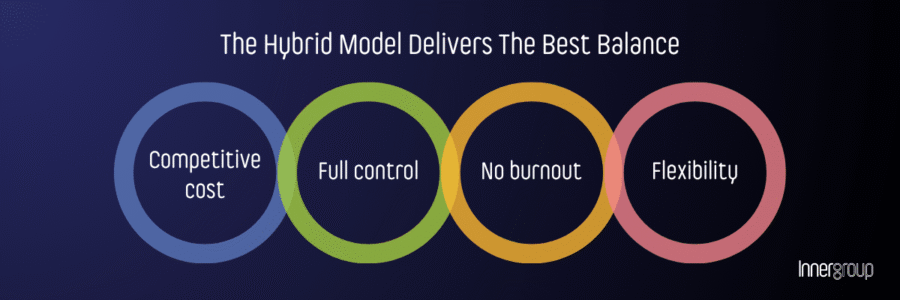
Why Hybrid Works for Brands
- You keep control over strategy. Your internal team sets direction. You’re not outsourcing strategic decisions.
- You get capacity without hiring. You can produce 10x more content, campaigns, creative assets without hiring 10 people. External production scales your output.
- You get specialized expertise when you need it. Fractional experts give you CMO-level thinking without full-time cost.
- You reduce fixed costs dramatically. If you need less next year, you scale back. If you need more, you scale up. Your fixed costs are lower.
How to Implement Hybrid Model At Your Brand
Step 1: Assess your current in-house team
What are you doing well? Where are the gaps? Where is the team stretched?This diagnostic determines everything that follows.
Step 2: Identify what you can outsource
Most in-house teams should outsource:
- High-volume content production (blog posts, social, email)
- Creative production (video, design, graphics)
- Routine tasks (scheduling, reporting, data entry)
Keep in-house: strategy, client relationships, brand voice, decision-making.
Step 3: Hire fractional experts for gaps
If you need leadership-level thinking but can’t justify a full-time hire, go fractional.
- Fractional CMO: Strategy, go-to-market, planning.
- Fractional content director: Content strategy, voice, quality.
- Fractional marketing ops: Workflow design, automation, reporting.
Step 4: Implement automation
Workflows, content production, email sequences, content scheduling, analytics reports—automate what can be automated.This compounds the effect of step 3. Your technology expert guides the automation. Automation executes.
External Agency vs. In-House Agency – Making The Right Call
You don’t have to choose in-house or external agency.
In 2026, the best model uses a mix of approaches. An in-house team handles strategy and brand voice. Fractional experts provide specialist insight.
Outsourced production helps you scale.This hybrid approach is what 46% of brands are now doing.
And they’re outperforming pure in-house and pure external agency models across the board.
Here’s how to decide:
- Assess your current state: How many people do you have? What are they spending time on?
- Where are the gaps? Not sure where your in-house team stands right now? Take a quick 5-minute InnerAssessment to find out.
- Identify your pain point: What’s driving this decision? Capacity? Cost? Lack of expertise? Marketing operations?
- Choose your model based on the pain: Don’t force yourself into in-house or agency. Choose the hybrid structure that solves your specific problem.
- Implement deliberately: Don’t just hire more people or hire a marketing agency. Design the model. Define roles. Set up systems.
What should you look for in a digital production company or content studio?
When evaluating digital production companies, consider:
- Do they specialize in your industry or have relevant experience?
- What’s their team structure? (Dedicated pod or rotating resources?)
- How do they handle quality control?
- What’s their communication model? (Formal or real-time?)
- Do they offer flexibility in engagement models?
- Can they handle your volume and speed requirements?
- Do they understand brand consistency as a priority?
There are several solid digital production companies in the market. Some focus on large enterprise clients with big budgets. Others specialize in startups. Some offer full-service capabilities. Others are production-only. The right choice depends on what you actually need.

Not Sure How to Choose Between In-House Agency Model and External Agency? Or How to Choose the Best for Your In-House Team?
The first step in taking any decision is to understand where you stand right now, what your current challenges are. They’re often not what you think. Use our free InnerAssessment tool. It’s a professional diagnostic that shows you:
- Where your team is spending time
- Where the capacity gaps are
- Which model would work best for your situation
- Where to start

Or, schedule a conversation with an expert. To talk through your specific situation and get personalized recommendations, we’re here.