
Hiring talent for your in-house agency is harder than it sounds.
Traditional recruiters understand job matching. They cast a wide net, screen candidates, and fill the opening with someone whose skills align with the requirements. On paper, it works. The person is talented. The credentials match.
But in-house agencies operate differently than most organizations. You’re handling expectations from all directions – multiple stakeholders, competing priorities, rapid iteration cycles. Your team needs speed and quality that matches those expectations. And the people working within that structure? They need to understand how in-house operations actually function. How to navigate stakeholder dynamics. How creative work actually moves through an organization.
Traditional recruiters don’t factor any of this in. They’re optimizing for resume fit, not operational fit.
The result: You hire marketing talent people who don’t work in your environment. They struggle with your pace. They don’t navigate internal politics well. They can’t adapt to your culture. Months later, they’re gone. You start the hiring process again.
Why Traditional Hiring Fails In-House Agencies
Traditional recruiting agencies don’t understand in-house agency workflows. They don’t grasp stakeholder dynamics or operational constraints. Their approach is one-size-fits-all—it fills the position, but only halfway.
They place the talent. But what about onboarding? Team integration? Continuous support?
That’s where the gap opens up.
And it’s bigger than it looks.
The position fills fast on paper. But integration is slow. There’s no cultural bridge. The person takes months to become actually useful. By the time you realize they’re a misfit—by the time the operational friction becomes undeniable—you’ve already lost time, money, and momentum.
You’re back to square one. Hiring again.
What is an in-house agency talent partner? How is it different
An in-house agency talent or staffing partner is built specifically with in-house marketing operations in mind. It is not a generic staffing solution, but a specialized partner to help you find the right embedded talent that fits seamlessly into your in-house marketing operations.
An in-house talent partner understands your world. It,
- Specialize in how in-house agencies actually operate
- Know internal structures, stakeholder dynamics, workflow pressures
- Understand the pace and communication style you need
- Supports not just talent placement, but also onboarding and integration
What should I look for in a creative staffing agency?
When evaluating a creative staffing agency for your in-house team, prioritize operational fit over resume credentials. Traditional hiring practices don’t work well for in-house agencies because talent that understands your brand and integrates organically into your working model matters far more than filling a position quickly and cheaply.
Vetting approach matters. Look for agencies that go beyond portfolio review and work samples. They should assess candidates on strategic thinking, attention to detail, technical acumen, collaboration skills, ability to stay within brand guidelines, and decision-making ability. Ask the agency to describe their vetting process—they should provide a clear methodology, not just forward profiles.
Integration support is non-negotiable. Avoid agencies that place talent and disappear (“dump and run” models). The staffing partner should take responsibility for onboarding and integrating the hire into your team. This is where most traditional placements fail—they place the person, but integration is left to you.
Specialization in brands matters. Generic staffing agencies use one-size-fits-all methods that work fine for external creative agencies but miss the unique demands of in-house operations. Your staffing partner should specialize in hiring for brands and understand in-house agency workflows.
Engagement flexibility is essential. Look for agencies that offer customizable engagement models based on your specific needs. Not every role requires full-time hire; some work better as fractional, short-term, or permanent placements. Your partner should be able to design the right model for your situation.
Talent depth across all tiers. The agency should have expertise hiring for every level—management positions, director-level roles, and individual contributors. They should also have a ready pool of talent that can be deployed quickly and backup talent available in case of sudden exits or leave of absence.
Clear communication on logistics. Ensure the agency communicates transparent pricing upfront with no hidden terms or last-minute surprises. They should also clearly communicate timelines for fulfilling positions and provide a clear escalation path for issues that arise.
Compliance and data protection. The staffing partner should agree to your brand’s privacy and data protection requirements—this is non-negotiable in regulated industries.
Staff Augmentation vs. Consulting: Understanding What You Actually Need
When in-house teams face capacity challenges, they often ask the same question: “Do we need more people or better strategy?”
The answer is usually: you need to understand the difference first.
Consulting and staff augmentation solve different problems. Confusing them costs brands time, money, and momentum.
What Consulting Does (And Doesn’t Do)
Consulting is about diagnosis and design. A consultant audits your operations, identifies what’s broken, and designs a solution. They answer: “What should we be doing differently?”
Consulting excels at:
- Identifying bottlenecks in your workflow or team structure
- Designing a better operational model
- Creating a roadmap for improvement
- Providing strategic direction and external perspective
Consulting falls short at one critical thing: execution. You can have the perfect operational blueprint, but if your team doesn’t have capacity to build it, the blueprint sits in a drawer. A consultant can tell you that you need to centralize your approval process or implement AI workflow automation. But if your team is already at 80% utilization, they can’t build it.
What Staff Augmentation Does (And Doesn’t Do)
Staff augmentation is about capacity and execution. You hire people—fractional, short-term, or permanent—to do work alongside your team. They answer: “How do we get more done with the resources we have?”
Staff augmentation excels at:
- Handling high-volume execution work
- Filling expertise gaps (a fractional CMO for strategy, a video producer for content)
- Scaling production without hiring permanent headcount
- Providing flexibility to match seasonal or project-based demand
Staff augmentation falls short at one critical thing: strategy. You can hire brilliant people, but without clear direction, they’re executing the wrong things efficiently. Adding three designers doesn’t help if you haven’t figured out what content actually matters. Adding a fractional CMO doesn’t help if your strategy is already misaligned.
The Restaurant Analogy (Why This Matters)
Imagine you own a restaurant. It’s busy. Overwhelmed.
Consulting is hiring a restaurant operations expert to audit your kitchen. They watch how you’re organized. They notice you’re over-ordering ingredients, running too many dishes simultaneously, and have confused handoff processes. They redesign your kitchen workflow and create a blueprint for efficiency.
Staff augmentation is hiring three line cooks to prep food while your head chef manages them. They get the work done. But if the kitchen’s still broken at a systems level, hiring more cooks just produces more output of the same broken processes.
The truth: You need both. But at different times, and for different reasons.
When You Need Consulting First
You need consulting when you’re not sure what’s actually broken. Symptoms include:
- Your team is busy but not strategic (65%+ of time on execution, not direction)
- You’ve implemented tools but they’re not working together
- Your in-house team doesn’t have clear prioritization
- You’re considering hiring more people but you’re not sure why
- Your operations feel inefficient but you can’t pinpoint where
Consulting diagnosis: “Before you hire more staff, let’s figure out if the problem is capacity or structure.”
In-house teams that start with consulting save money. They avoid hiring people they don’t need and instead fix the structural issues that would plague any team, no matter how large.
When You Need Staff Augmentation
You need staff augmentation when you know what you’re trying to do but lack the hands or expertise. Situations include:
- You have a clear strategy but your team is at capacity
- You need specialized expertise you don’t have (fractional CMO, video producer, ops specialist)
- You have seasonal or cyclical demand (holiday campaigns, product launches)
- You want to test a new capability before hiring permanently
- Your core team is stretched across too many functions
Staff augmentation works because: You already have direction. You already have leadership. You just need execution or specialized thinking.
The Sequence That Works
The best in-house teams don’t choose between consulting and staff augmentation. They layer them strategically:
Phase 1: Audit (Consulting)
Get a clear diagnostic of what’s actually broken. Where is capacity constrained? Where is strategy unclear? Where is the system inefficient?
Phase 2: Design the Fix (Consulting)
Based on the audit, design the operational model you need. This might mean restructuring your team, implementing automation, or reorganizing how work flows.
Phase 3: Augment to Build (Staff Augmentation)
While your core team leads the change, bring in staff to handle execution. Fractional experts for strategy gaps. Additional hands for production gaps. Temporary resources to handle the transition.
Phase 4: Ongoing Support (Hybrid)
As your operations evolve, you might need periodic consulting (for strategy or optimization) and ongoing staff augmentation (for capacity or expertise).
Why In-House Teams Are Positioned for This Model
External agencies don’t have this luxury. They can’t layer consulting and staff augmentation because they don’t own the strategy. In-house teams do. This means:
- You can hire a consultant to design your operations without losing control
- You can hire staff to execute on that design while your team leads
- You can layer both over time, evolving your model as your business changes
- You own the outcome, not the vendor
How to Decide What You Actually Need
Ask yourself these three diagnostic questions:
1. Do you know what’s broken?
If no → You need consulting first
If yes → You likely need staff augmentation
2. Do you have capacity to lead the work?
If no → You need a fractional leader (consulting + staff)
If yes → You need production staff (staff augmentation)
3. Does your team know how to build the solution?
If no → You need consulting expertise
If yes → You need execution capacity
Your answers determine which service you need first—and whether you need both.
Staff Augmentation vs. Managed Services: When to Choose Each
When in-house teams decide they need external support, they face a critical choice they often don’t realize they’re making: staff augmentation or managed services.
The difference determines who controls the work, who makes decisions, and how much flexibility you retain. Getting this wrong costs you control over your operations.
What Staff Augmentation Actually Is
Staff augmentation means hiring people—fractional, short-term, or permanent—who report to you and execute your direction. You own the strategy. You own the decisions. The augmented staff handles the execution.
Examples:
- Hiring a fractional CMO who attends your leadership meetings and shapes strategy with your team
- Bringing in a senior media operator for 90 days to restructure your paid media function
- Embedding a creative technologist to design AI workflows for your production process
In all cases: You direct. They execute.
What Managed Services Actually Is
Managed services means hiring a vendor to handle the entire function—including managing the team doing the work. The vendor owns the execution decisions. You own the relationship with the vendor.
Examples:
- Hiring a creative production agency to “handle all your content production” (they hire the team, manage them, report results)
- Hiring a consulting firm to “optimize your marketing operations” (they hire the people, do the work, hand you results)
- Hiring a marketing ops firm to “manage your tech stack” (they own the decisions, you see the outcomes)
- In all cases: Vendor directs. You see results.
When Staff Augmentation Wins
Choose staff augmentation when:
1. You have clear strategy but lack capacity
You know exactly what you need done. You know how to lead. You just need people to execute. Staff augmentation lets you hire exactly the right people without outsourcing your decision-making.
Example: Your content strategy is solid, but your team is at 90% utilization. Bring in a fractional content producer to handle execution while your strategist leads.
2. You need specialized expertise, not a full-time hire
You need CMO-level thinking about go-to-market strategy, but you don’t have a CMO and can’t justify $200K/year. A fractional CMO gives you the expertise without the overhead.
Staff augmentation solves this. Managed services doesn’t—managed services would hire an agency to be your CMO, which costs even more.
3. Speed and responsiveness matter
You need to iterate quickly. Feedback loops are tight. Decisions need to happen in hours, not days.
Staff augmentation works because your people work inside your systems. Managed services is slower because every change requires vendor approval.
4. Your brand voice or strategic direction is mission-critical
If differentiation is competitive advantage (luxury brands, thought leaders, high-regulation industries), you need direct control over creative and strategic decisions.
Managed services dilutes this because the vendor is optimizing for their own efficiency, not your unique positioning.
5. You want to test something before committing
You’re not sure if you need a full-time video producer or whether outsourcing video makes more sense. Hire a fractional video specialist for 60 days. Learn what works. Then decide.
Managed services doesn’t give you this optionality—you’re locked into a vendor relationship.
When Managed Services Wins
Choose managed services when:
1. You don’t have strategic clarity
You’re not sure what needs to happen. You need someone to audit, diagnose, and design the solution. Managed services (in the form of consulting) is appropriate here.
But note: This is consulting, not staff augmentation. Different beast entirely.
2. You want to completely outsource a function
You don’t want to manage people at all. You want a vendor to own the entire function—hiring, managing, optimizing, reporting results.
This works if the function is non-strategic. Content production, social media management, routine analytics reporting.
3. Consistency of vendor matters more than flexibility
You need one accountable vendor. You don’t want to manage multiple fractional people or a rotating team. Managed services gives you a single point of contact.
4. You lack internal leadership for the function
You have no one to direct the work. No one who understands the strategic direction. Managed services means the vendor brings leadership.
The Hybrid Reality
The best in-house teams don’t choose just one.
They use staff augmentation for strategic/expertise gaps (fractional CMO, embedded technologist, operations specialist). These people work inside your team and report to your leadership.
They use managed services for non-strategic execution (content production, routine reporting, social media management). These vendors own the tactical work.
How to Decide
Ask yourself:
1. Do I have strategic clarity on this function?
Yes → Staff augmentation
No → Consulting first, then staff augmentation
2. Do I have or can I hire leadership for this function?
Yes → Staff augmentation
No → Managed services OR hire a fractional leader + staff augmentation
3. How mission-critical is this to competitive differentiation?
Very → Staff augmentation (you need control)
Not at all → Managed services (you can outsource)
4. How much iteration/responsiveness do I need?
High → Staff augmentation (faster feedback loops)
Low → Managed services (outcomes matter more than process)
Your answers determine the right model. Most in-house teams need both—staff augmentation for strategy and control, managed services for execution and scale.
Why In-House Teams Are Positioned to Use Both
External agencies can’t use staff augmentation because they don’t own strategy. In-house teams do. This gives you unique flexibility:
- You can hire fractional experts without losing strategic control
- You can augment capacity without building permanent overhead
- You can layer both over time as your business evolves
- You own the outcome, not the vendor
What is InnerTalent? What Makes it Different
InnerTalent is a specialized staffing solution designed by InnerGroup to help in-house agencies get continuous access to creative, operational, and strategic talent that is embedded right into their team and operational workflow.
InnerTalent (noun)
A specialized staffing solution designed for in-house agencies. Provides continuous access to embedded creative, operational, and strategic talent integrated directly into your team’s workflow.
We combine operational understanding with deep knowledge of your business to deploy talent quickly, precisely and with immediate impact.
As experts in in-house marketing operations, we bring context and expertise traditional recruiters can’t—reducing friction, accelerating onboarding, and ensuring the right fit from day one.
We don’t just place talent–we design the right engagement model based on geography, risk, and how your team actually operates.
How does embedded talent solutions differ from traditional hiring methods?
Embedded talent solutions differ fundamentally from traditional hiring approaches in how they match, assess, and support talent placements.
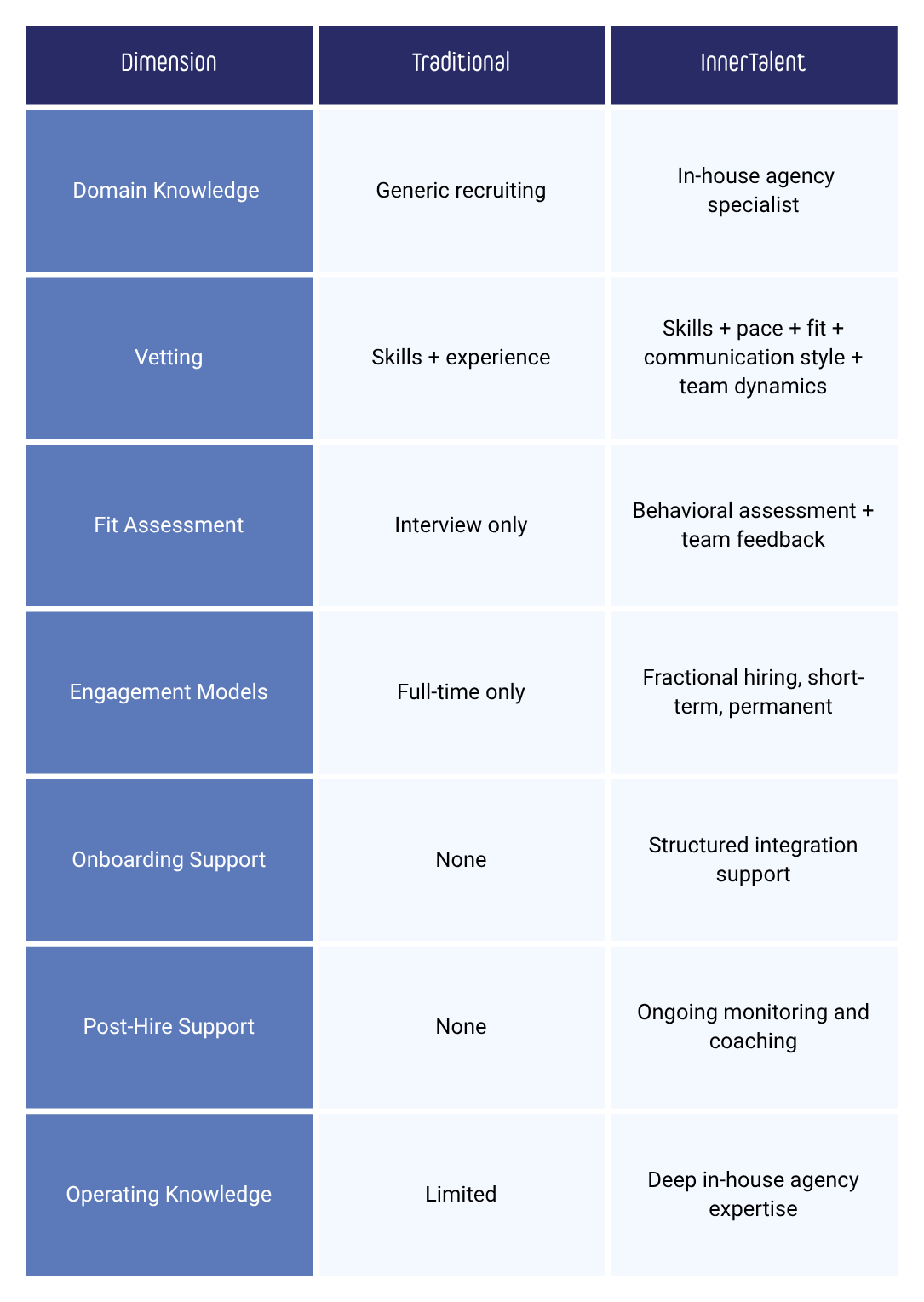
Traditional recruiting focuses on resume fit—screening candidates against job requirements and filling the position with someone whose credentials align with the role. This works for generic organizations, but in-house agencies operate differently. They have unique workflows, stakeholder dynamics, pace expectations, and cultural pressures that generic recruiters don’t understand. As a result, candidates who look great on paper often struggle in the actual environment.
Embedded talent solutions are built specifically for in-house operations. They start by understanding your team’s actual operational reality—your workflows, what’s working, what’s broken, and what’s changing. This deep context allows them to match talent not just on skills but on whether they can actually thrive in your environment.
Beyond operational understanding, embedded talent partners assess candidates on dimensions that traditional recruiters ignore: pace adaptation, communication style, tech fluency, and what we call ‘in-house agency DNA’—the ability to handle feedback, manage ambiguity, and navigate internal dynamics. These distinctions matter more than years of experience or portfolio quality.
Engagement flexibility is another key difference. Embedded talent solutions recognize that not all roles need permanent, full-time hires. They offer fractional hiring for specialized expertise, short-term engagements for transitions and stabilization, and permanent placements for core roles. Traditional recruiters typically handle only permanent placements.
Finally, embedded talent partners stay engaged post-placement. They don’t hand off the candidate and disappear. They monitor fit, support onboarding and integration, and course-correct if something isn’t working. They’re invested in long-term success, not just transaction completion.
InnerTalent Engagement Models Explained
We understand that every in-house operation is different. That’s why we’ve designed multiple engagement models for InnerTalent—each structured for the specific needs that arise in in-house marketing operations.
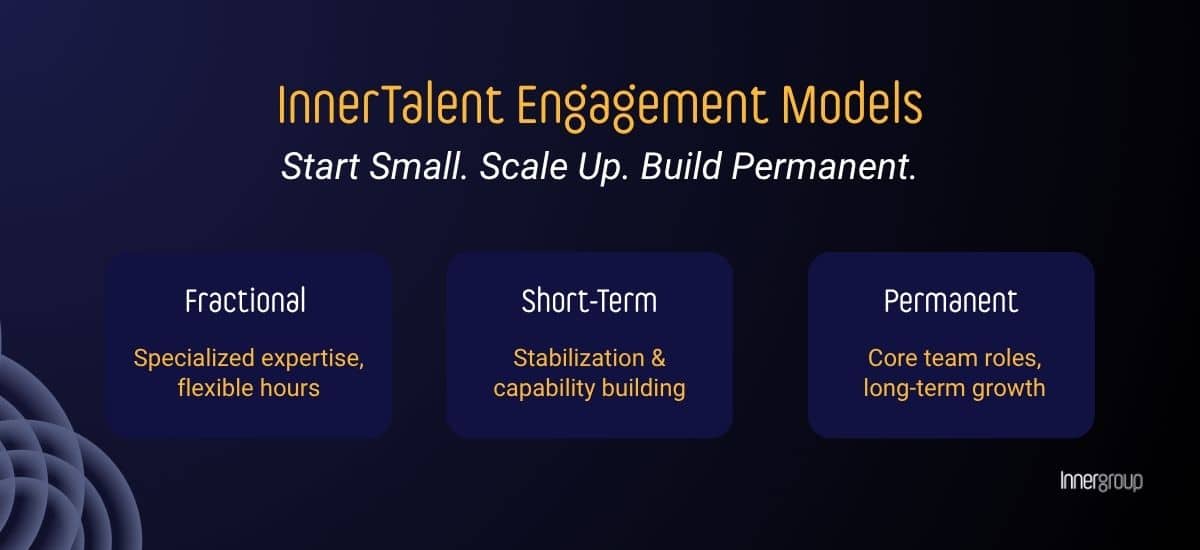
- Fractional Hiring (as needed and flexible duration)
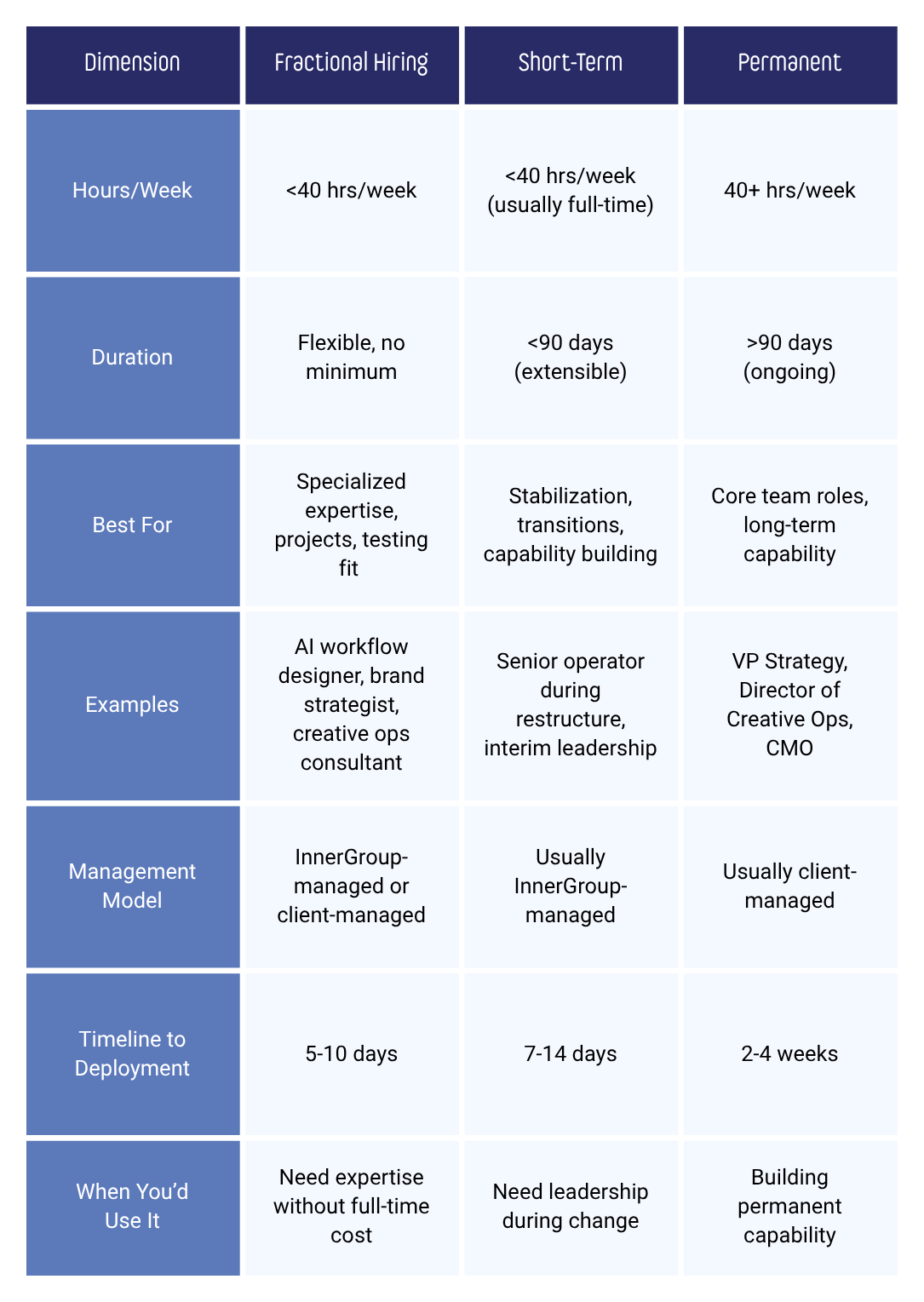
Fractional hiring works best when in-house agencies need specialized expertise but only for limited hours per week—an AI workflow designer, fractional CMO, brand strategist, or creative ops consultant.
The person works part-time with flexible hours. Duration is flexible and tied to your project timeline. You define the scope, and the contract can be extended or converted to full-time if it’s working well. This model is ideal for low-risk exploration, seasonal demand spikes, or filling temporary gaps.
Examples:
- A brand strategist embedded 15 hours/week to guide positioning work while your internal team executed
- A creative technologist working 20 hours/week to design and implement AI workflow automation
- A paid media expert supporting 25 hours/week during peak season, scaling down post-holiday
- Short-Term / Medium-Term
In-house agencies prefer this engagement model when they are in transition, leadership change, restructuring their team, or rebuilding a function. In this type of engagement, the talent embeds full-time but for a limited period of time (>90 days). The contract is extensible if they find a fit.
This type of talent model focuses on stability and capacity building instead of ongoing delivery. The embedded talent trains the team, performs the required actions and leaves the team stronger.
Examples:
- A senior media operator embedded during paid media function reorganization (see case study below)
- A creative ops leader parachuting in during a VP transition to stabilize operations
- An interim creative director guiding strategy during leadership gaps
- Permanent / Full-Time
Permanent is preferred when in-house agencies are building core capability for long-term roles—head of strategy, director of creative ops, chief marketing officer. InnerTalent facilitates the hiring process while you own performance and management.
The contract structure can vary. Some brands prefer InnerGroup-managed (we handle performance, support, and delivery). Others prefer client-managed (you own the relationship directly). Choose based on your support needs and comfort level.
InnerTalent Management Models Explained
There are two types of management models InnerTalent offers to in-house agencies.
- InnerGroup-Managed: In this model, InnerTalent finds, vets, onboards and manages the talent including its performance and ongoing support. This type of contract is good for transitions and high-risk placements.
- Client-Managed: InneTalent finds, vets, and onboards the talent and integrates it into the in-house agency. However, the performance and delivery are managed by the brand itself. This type of contract situation is preferred for senior, permanent hires.
InnerTalent places talent across 5 core areas
We place talent across every function that is requisite for an in-agency including the traditional roles as well as future-proofing roles.
Creative
- Brand designers, digital designers, UX designers, motion designers
- Art directors, creative directors
- Copywriters (by vertical)
- Video editors
Production & Operations
- Project managers, producers
- Creative ops leads, workflow specialists
- Events/experiential producers
- Schedulers and coordinators
Strategy & Marketing
- Brand strategists, content strategists
- Marketing strategists, campaign managers
- Program managers, field marketers
- Insights and analytics leads
Data & Analytics
- Marketing analysts, performance marketers
- Data strategists, analytics leads
- Attribution specialists
Future-Proofing Roles (AI, Automation, Tools)
- Gen AI specialists
- Creative technologists, AI workflow designers
- Workflow/systems specialists
- AI/tooling specialists
- Community managers, content creators
Our talent vetting process
We go beyond the traditional resume and portfolio to find the perfect match for your in-house agency. Our meticulous vetting process includes resource analysis on the basis of following parameters:
- Speed – We make sure that the talent selected by us is able to work in high-speed environment of an in-house agency.
- Communication – Communicate is a key for an in-house agency to work efficiently. We vet the resource on the basis of the communication method they prefer and establish a match with the in-house agency. Do they prefer async or real-time collaboration? Can they manage ambiguity? These seem like tiny details but are very important to establish a strong team dynamic within an in-house agency.
- Tech fluency – Tech fluency cannot be missed in this time of AI. Any resistance towards technology can hamper productivity and create friction within the team. Hence we make sure that the resource is fluent in technology and is quick to adapt.
- In-house agency DNA – This is a primary differentiator while selecting a resource for in-house placement. The talent should be comfortable and familiar with the mechanisms of an in-house agency. They should be able to handle feedback, rush-hour requests, multiple iterations, and internal dynamics to thrive in an in-house environment.
How InnerTalent works – Our 5-step process
Whether you’re hiring a fractional marketing team or an embedded talent, InnerTalent makes sure that only the right person is placed in your in-house agency. Our process is rigorous but not rigid, flexing with different demands, timelines, and depths.
- Understanding your operational reality
It starts with an assessment. We don’t just ask what role you want to fill. We go in-depth on your operational structure and team dynamics. We understand what’s working, what’s broken, what’s changing within your team—so we can map the right talent for you.
This isn’t a checklist exercise. It’s an exploration of the actual environment we’re hiring into.
Defining roles and responsibilities
A simple job description isn’t enough to find the right talent fit. We create an in-depth expectation map that answers critical questions: What work will they own? Who do they report to? What decisions do they make? What does success look like in this role?
This clarity helps both the in-house agency and the candidate understand the fit before commitment happens.
Talent shortlisting
Based on the expectations, job descriptions and the operational reality of the in-house agency, we vet the candidates and present a list of carefully-curated talents. We focus on quality over quantity.
Interview & selection process
InnerTalent team that has vast experience building and scaling in-house teams, manages the interviews. We assess the candidate beyond their traditional skills and share the final selection along with the negotiated pay with the in-house agency.
Onboarding & team integration
This is where traditional recruiters disappear. We don’t just place talent and vanish. We stay engaged throughout onboarding and integration. We work with your team to design an integration plan that helps the candidate understand your culture, workflows, and expectations. We do regular check-ins, especially in the first 90 days, to ensure the fit is working and the candidate is integrating as expected.
Fractional hiring vs. full-time vs. short-term – How to decide
Different situations call for different engagement models. Choosing the right one means faster results and lower risk.
Why should in-house agencies choose InnerTalent for recruitment
We’re not a regular recruitment agency that caters to a wide range of industries. We were built by the in-housers, for the in-house agencies, keeping the specific needs of brands in mind. But this is not the only reason why in-house agencies should choose InnerTalent for marketing staffing solutions.
- We understand the challenges and ambitions of in-house agencies. This is what general recruiters miss. With our domain expertise of over 20 years, we can predict cultural fit with real data.
- We don’t just fill in the position, we find the operational fit for your in-house agency. We analyze your team’s strengths, frictions, limitations and growth trajectory and only then create a curated list of talent. We match the talent with your operational reality, not just job description.
- We analyze the talent on the basis of style, tech fluency, communication, prior in-house experience over and above the traditional resume/portfolio. You only interview people who understand your world and de-risk hiring people who aren’t fit for in-house agency’s fast-paced environment.
- Multiple engagement models to fit your unique requirements. We believe that one size doesn’t fit all. So we designed 3 unique models each suited to unique staffing situation. Whether it’s for long-term or short-term, fractional hiring or full-time, you will find a model that works for you.
- We don’t do the vanishing act on you. Our support is ongoing, right from recruitment, onboarding to integration. We monitor fit and performance and help you build long-term capability.
Traditional recruitment solutions vs. InnerTalent – How we differ
How does InnerTalent’s approach differ from traditional recruiting? Here’s the honest comparison:
Getting started with InnerTalent – Hiring talent for in-house agency
Hiring the right talent is the highest-leverage decision an in-house agency leader can make. That’s why it’s important that you do it right.
And we can help you do it right, within the specified timeline. The process is simple.
- Fill out the talent intake assessment. Answer a bunch of simple questions that will help us gauge your operational situation, expectations, and success metrics. It just takes 4 minutes.
- Or simply reach out to us with your talent requirement and we can come back to you with a quick hiring plan.
- We understand your situation and suggest the right engagement and management model for you. Once you pick the model that fits, we take it from there and handle the rest.
- From shortlisting to interviews, we handle everything.
You focus on your business. We focus on finding and integrating the right talent.